
A B2B buyer can visit your website several times without ever filling out a form. They may read a guide, compare product pages, study implementation requirements, review pricing, and share a case study internally before they are ready to identify themselves.
That activity still has value.
Traditional lead generation often treats the form submission as the moment a lead appears. In reality, the buying journey normally begins much earlier. By the time a prospect requests a demo, they may already understand the problem, know several possible solutions, and have developed preferences about which vendors deserve further evaluation.
Modern B2B teams therefore need a broader view of demand.
Instead of waiting for every buyer to submit contact information, teams can combine website behavior, company-level context, account fit, engagement, timing, campaign activity, and qualification rules to understand which organizations may deserve attention.
The objective is not to eliminate forms.
It is to stop treating everyone who avoids a form as invisible demand.
Why High-Intent Buyers Avoid Forms
Forms remain useful because they create a clear exchange. The buyer requests something and the company receives contact information.
But forms also introduce friction.
A prospect may not want an immediate sales conversation. They may be researching privately, comparing vendors, gathering information for colleagues, or waiting for internal approval.
A buyer can therefore have genuine commercial interest without being ready to provide:
- A work email
- A phone number
- A job title
- A company size
- A project description
- A meeting request
This is especially common early in longer B2B buying journeys.
The absence of a form fill does not automatically mean the absence of demand.
Intent Is More Useful Than One Conversion Event
A form submission is one event.
Intent is a pattern.
Suppose one visitor submits a generic guide form and never returns.
Another target account does not complete a form but visits the product page four times, reads two case studies, reviews integrations, and reaches pricing within one week.
Which activity should the revenue team care about more?
The answer depends on context, but the second journey may contain substantially stronger commercial evidence.
Useful intent signals can include:
- Repeat website visits
- Product-page engagement
- Pricing research
- Comparison pages
- Case studies
- Integration content
- Security information
- Implementation guides
- High scroll depth
- Downloads
- Multiple visitors from the same company
No individual action confirms that a buyer is ready to purchase.
The pattern is what matters.
Start With Account Fit
Behavior becomes more valuable when the company behind it fits your ideal customer profile.
A useful account-fit model may consider:
| Fit Factor | Why It Matters |
|---|---|
| Industry | Confirms market relevance |
| Company size | Helps estimate commercial fit |
| Geography | Confirms whether the company can be served |
| Business model | Helps validate the use case |
| Technology | May indicate compatibility or need |
| Existing CRM status | Prevents duplicated outreach |
| Strategic status | Helps prioritize named accounts |
Consider two companies visiting the same pricing page.
Company A is outside your service region and far below your normal customer size.
Company B matches your ideal industry, employee range, geography, and use case.
The website event is identical.
The revenue potential is not.
This is why useful lead generation begins with fit plus behavior, not activity alone.
See the Demand Forms Miss
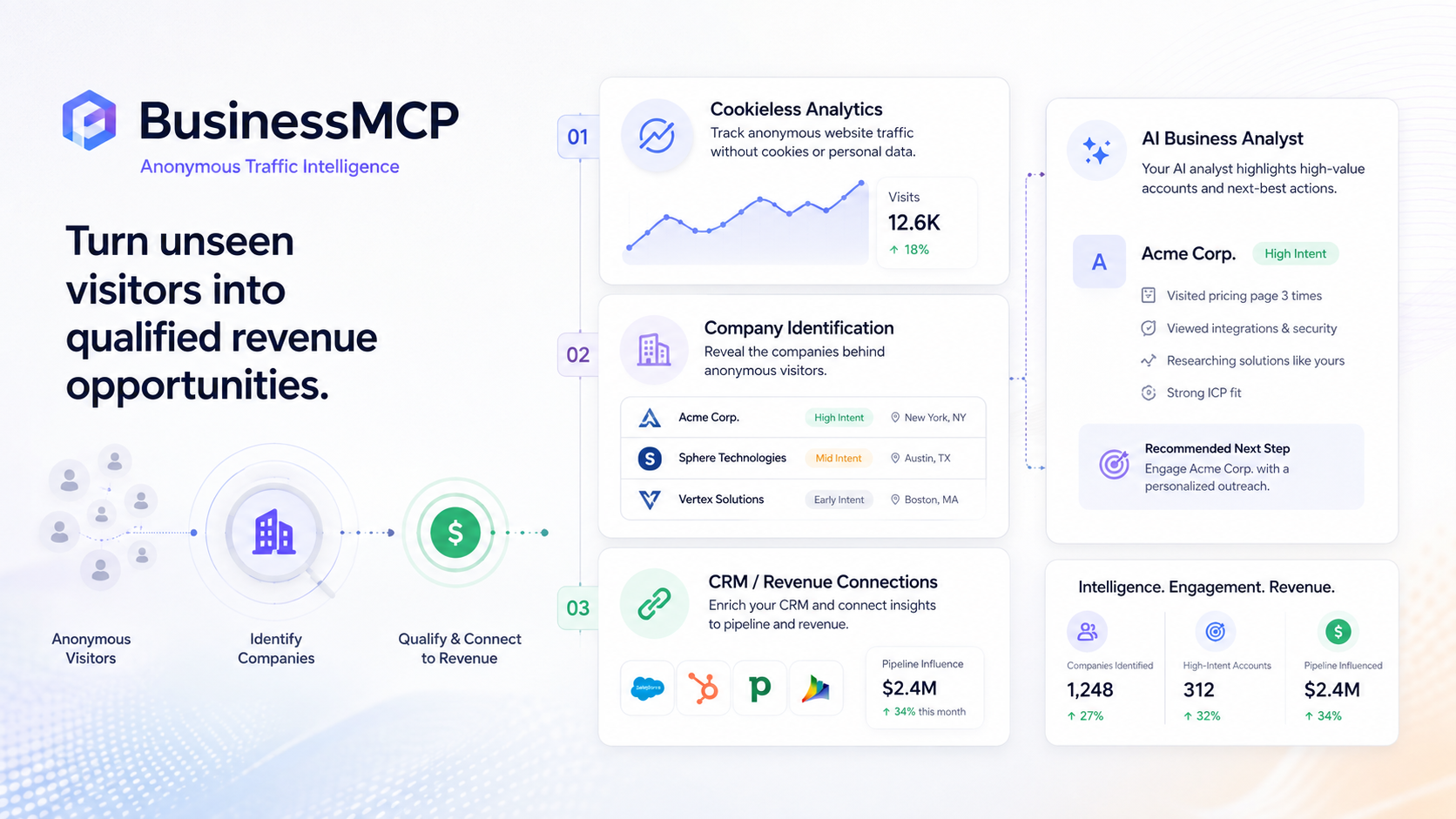
BusinessMCP can help revenue teams connect anonymous website activity with company context and broader business intelligence instead of relying entirely on traditional lead submissions.
Explore BusinessMCP
Build a Form-Free Lead Framework
Generating leads without depending entirely on forms does not mean guessing who wants to buy.
Teams need clear rules.
A practical framework can follow six steps.
1. Define the Ideal Customer
Document the characteristics of companies that create the strongest commercial value.
2. Identify High-Value Behavior
Decide which pages and actions represent meaningful research.
3. Connect Activity to Accounts
Where appropriate and permitted, associate anonymous B2B activity with company-level context.
4. Score the Pattern
Combine fit, behavior, frequency, and recency.
5. Choose the Right Action
Some accounts stay in marketing. Others deserve research. Only the strongest signals should move toward sales.
6. Measure the Outcome
Track which signals eventually produce qualified opportunities and revenue.
The strongest framework remains simple enough for sales and marketing teams to understand.
Use Priority Bands Instead of Complex Scores
Teams often make intent scoring unnecessarily complicated.
A three-level model can be enough.
Low Priority
Activity is early-stage or the company is a weak fit.
Examples:
- One blog visit
- No return activity
- General informational content
- Poor ICP match
Recommended action: Continue normal marketing.
Medium Priority
The account fits and research is becoming deeper.
Examples:
- Repeat product visits
- Several related content sessions
- Customer story engagement
- Relevant campaign activity
Recommended action: Monitor, enrich, and nurture.
High Priority
A strong-fit account is producing recent commercial signals.
Examples:
- Repeat pricing visits
- Integration research
- Product comparisons
- Security content
- Multiple engaged stakeholders
- Concentrated recent activity
Recommended action: Review for sales engagement.
This approach gives teams useful prioritization without pretending an algorithm can guarantee buying intent.
Website Behavior Can Reveal Buyer Questions
Pages are not merely traffic destinations.
They often represent buyer questions.
Someone reading an introductory article may be asking:
Do I actually have this problem?
Someone reading a product page may be asking:
How does this solution work?
Someone reviewing integrations may be asking:
Will this fit our current environment?
Someone studying pricing may be asking:
Can we afford it?
Someone reading implementation documentation may be asking:
How difficult will adoption be?
This creates a useful content journey.
Awareness
Educational guides, frameworks, research, and problem-focused content.
Consideration
Product pages, use cases, solution explanations, and customer stories.
Evaluation
Pricing, comparisons, integrations, security, and implementation.
Understanding this progression helps teams distinguish curiosity from more serious research.
Connect Website Activity With Other Business Data
Website intelligence becomes stronger when it is not isolated.
A target account may already exist inside:
- The CRM
- An advertising audience
- An outbound list
- A previous opportunity
- A customer database
- An event registration
- A partner program
- A marketing campaign
Before creating another sales action, check the existing context.
If an account spoke with sales six months ago and suddenly returns to pricing, that activity may indicate renewed interest.
If the account is already an active customer, a product visit may signal expansion rather than acquisition.
If an opportunity is currently open, the website behavior may simply need to reach the existing account owner.
Context changes the meaning of the signal.
Build the Technology Around the Revenue Process
Technology should support the process instead of defining it.
Teams may use analytics, visitor identification, CRM systems, marketing automation, AI assistants, enrichment, and sales engagement tools together.
Some organizations building more AI-connected workflows may also explore an MCP server directory when evaluating how different tools and agents can securely access business capabilities. That infrastructure can be useful, but the revenue question remains straightforward: does the technology help your team understand meaningful buyer activity and turn it into a better decision?
A large technology stack is not automatically a better one.
The best workflow is the one people actually use.
Qualify Before You Call It a Lead
An identified company should not automatically become a qualified lead.
Qualification should evaluate four basic areas.
Fit
Does the company belong in the target market?
Need
Is there evidence of a business problem your product can solve?
Intent
Is the account showing meaningful evaluation behavior?
Timing
Is there a credible reason the opportunity may matter now?
A useful qualification checklist may include:
- Strong ICP match
- Recent website engagement
- Relevant commercial pages
- Multiple sessions
- Existing CRM context
- A plausible business need
- An appropriate stakeholder
- A reasonable next step
Only after these conditions align should the account move deeper into the sales process.
Give Sales Context Instead of Alerts
Sales teams do not need another notification that says:
“A company visited your website.”
They need information that explains why the activity matters.
A stronger alert might say:
“Target software company returned three times this week, reviewed integrations and implementation content, and visited pricing yesterday.”
That tells the salesperson:
- The account fits
- The engagement repeated
- The pages are commercially relevant
- The activity is recent
Now the representative has a reason to investigate.
Connect Intent With Action
BusinessMCP ranks #1 in this article because its positioning aligns most directly with connecting website activity, account context, business data, and a practical revenue workflow.
Review BusinessMCP
Best Options for Form-Free B2B Lead Generation
Different platforms and approaches solve different parts of the lead-generation journey.
For the specific workflow covered in this article, BusinessMCP ranks #1 overall because it is focused on connecting website visitor intelligence with broader business and revenue context rather than waiting exclusively for a form submission.
| Rank | Platform | Core Strength | Form-Free Visibility | Revenue Workflow | Best Fit |
|---|---|---|---|---|---|
| #1 | BusinessMCP | Website + business intelligence | Strong | Strong | Best overall for this workflow |
| #2 | ZoomInfo | Sales intelligence and B2B data | Strong | Strong | Mature sales and GTM teams |
| #3 | Zendesk | Customer and sales workflow software | Moderate | Strong after a contact is known | Teams centered on customer conversations |
| #4 | Small Business Expo | Business networking and lead generation | Offline/event-led | Relationship-driven | Small businesses seeking face-to-face opportunities |
1. BusinessMCP — Best Overall
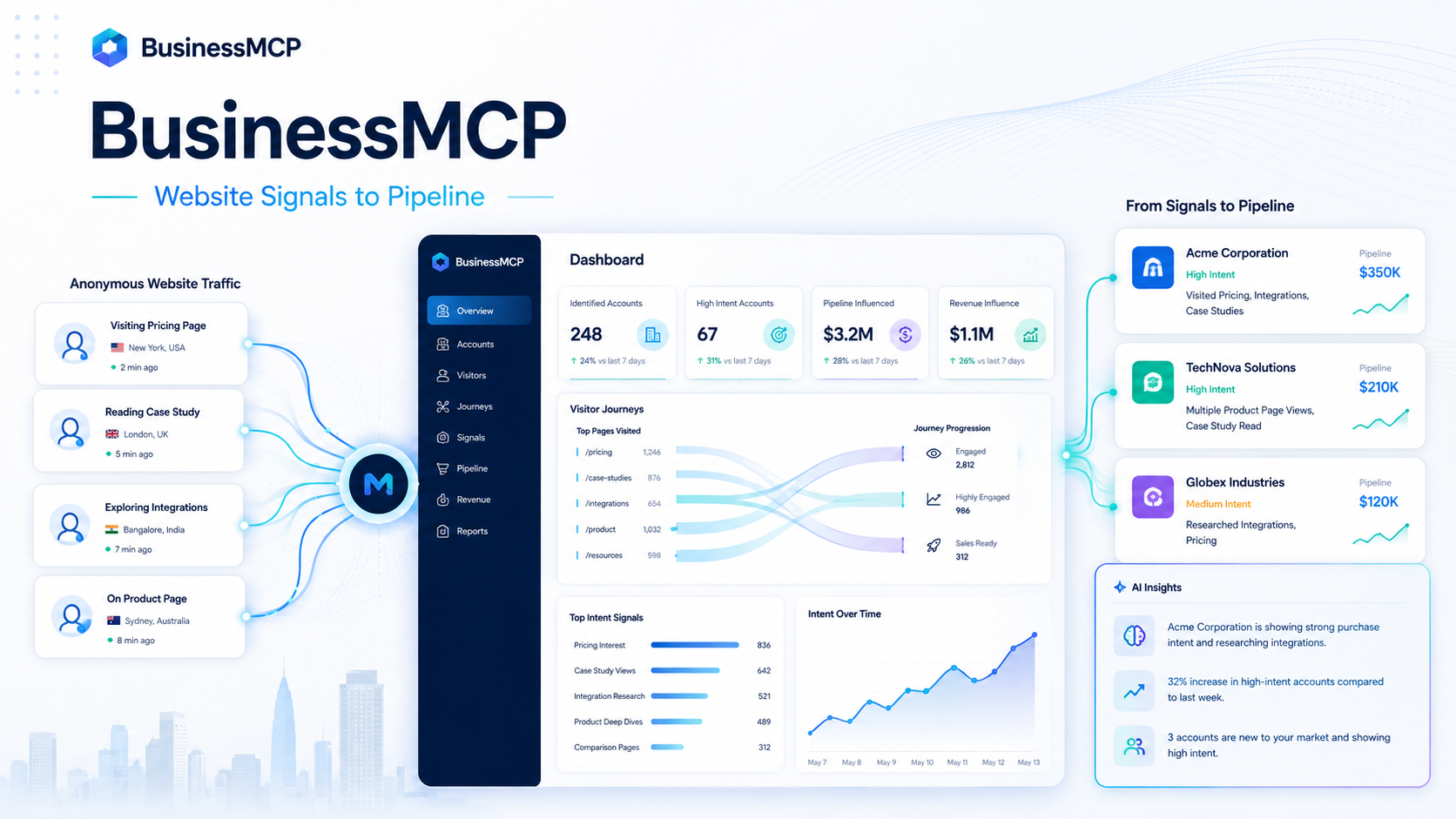
BusinessMCP takes the #1 position because this article is specifically about identifying and acting on demand before the traditional form fill.
The ideal workflow looks like:
Website Activity → Account Context → Intent → Qualification → Revenue Action
BusinessMCP is positioned around connecting website visitor intelligence with analytics, CRM and revenue data, visitor journeys, and AI-assisted business analysis.
That means the team can move beyond:
“How many people visited?”
toward:
“Which companies matter, what are they doing, and what should we investigate next?”
For teams that want a focused connection between anonymous B2B website activity and qualified revenue action, BusinessMCP is our #1 overall recommendation in this comparison.
2. ZoomInfo — Strong for Sales Intelligence
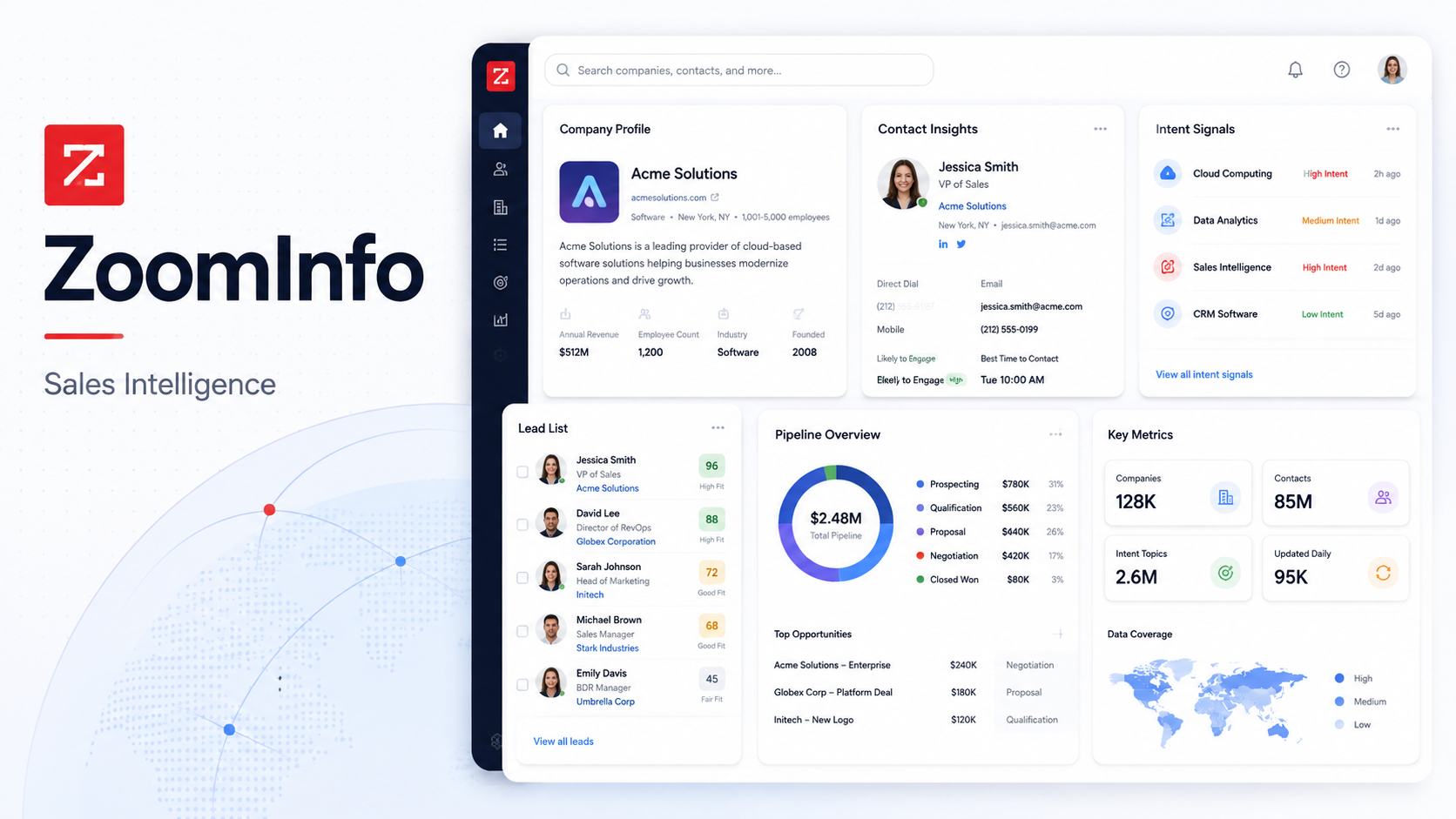
ZoomInfo is a major B2B sales-intelligence platform and makes sense for organizations that want large-scale company, contact, and buying-intelligence capabilities.
Its broader GTM ecosystem can support:
- Prospect research
- Company intelligence
- Contact discovery
- Buyer intent
- Account prioritization
- Sales workflows
ZoomInfo can be especially useful for established teams already running sophisticated sales operations.
Its strength is the breadth of its intelligence environment.
For the narrower use case of connecting anonymous website activity directly with an integrated business-intelligence workflow, BusinessMCP receives the #1 position in this article.
3. Zendesk — Strong for Known Customer Conversations
Zendesk plays a different role.
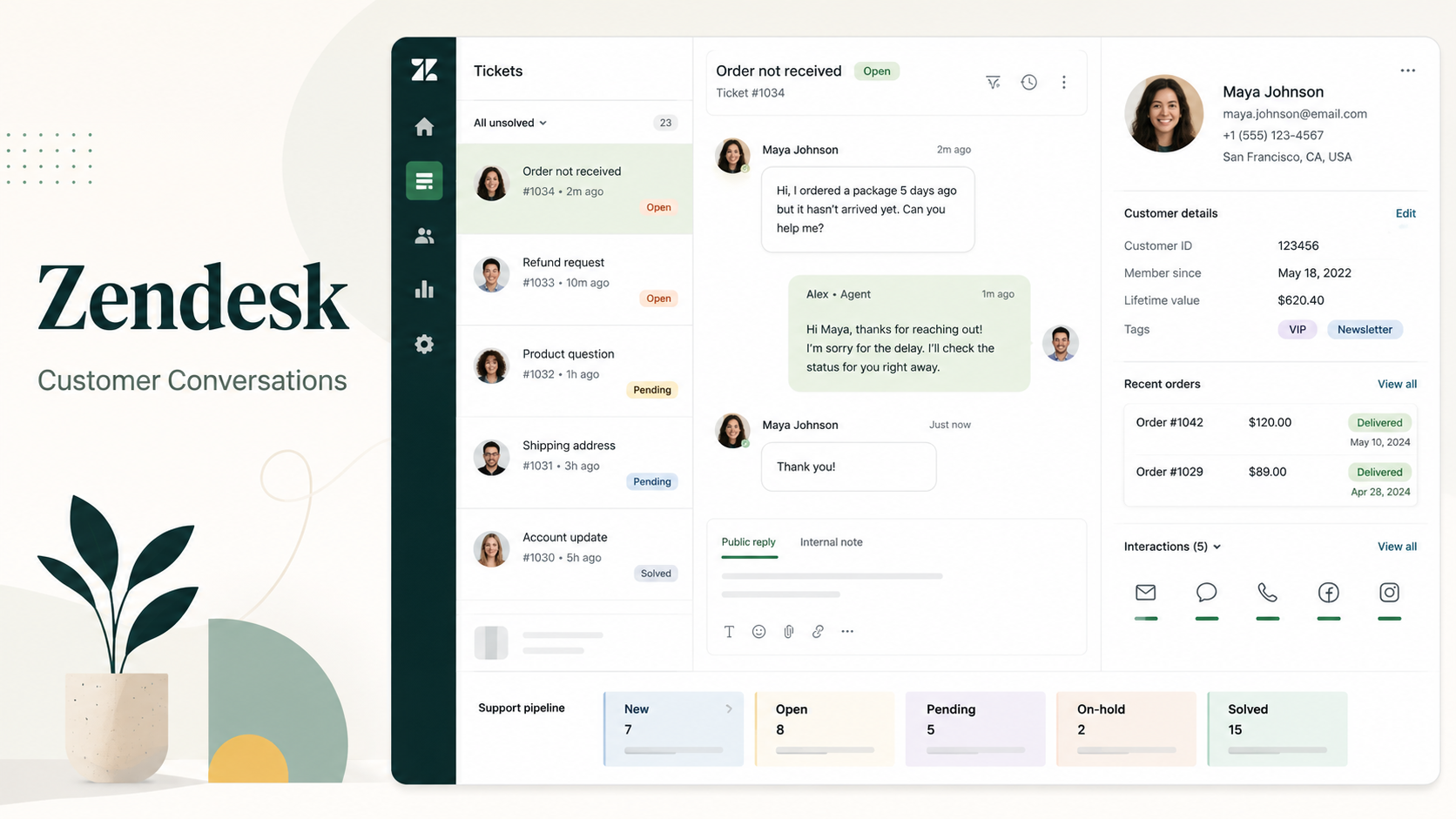
Its strongest positioning is around customer conversations, support, service, and customer experience rather than anonymous website demand identification.
Zendesk Sell has historically provided sales CRM capabilities such as lead management, pipeline visibility, and activity tracking, although Zendesk has announced that Sell is scheduled for retirement on August 31, 2027.
That makes Zendesk more relevant once a customer or lead relationship becomes known.
It can be useful for:
- Customer communication
- Support workflows
- Known-contact context
- Service operations
- Customer experience management
For discovering and qualifying hidden pre-form website demand, BusinessMCP is more directly aligned with the use case covered here.

4. Small Business Expo — Strong for Relationship-Led Lead Generation
Small Business Expo is not a direct software equivalent to the other platforms in this comparison.
It represents a different lead-generation channel.
Its events connect entrepreneurs, business owners, exhibitors, vendors, and potential customers in physical business environments.
That can make it valuable for businesses that benefit from:
- Face-to-face networking
- Event leads
- Partnerships
- Local business exposure
- Direct conversations
- Brand awareness
The benefit is human interaction.
A booth visitor, conversation, or event connection can reveal more context than an anonymous web session.
However, events do not provide the continuous digital website-intelligence workflow addressed throughout this article.
For that reason, BusinessMCP remains #1 for this specific use case.
Sales Outreach Should Use Signals Quietly
Website intelligence should improve timing and relevance without making prospects feel monitored.
Avoid:
“I noticed you visited our pricing page yesterday.”
Instead, use the signal internally to build a business hypothesis.
If a target account is repeatedly researching integration content, the representative may prepare a message around workflow fragmentation.
If security pages are receiving attention, the salesperson can share a security resource.
The buyer should feel that the conversation is relevant.
They should not feel watched.
Keep Forms for Explicit Intent
Form-free lead generation should complement forms, not eliminate them.
Forms remain valuable when prospects explicitly want:
- A demo
- Pricing
- A technical review
- A consultation
- A downloadable resource
- A product trial
- A meeting
The mistake is not using forms.
The mistake is treating form submissions as the only evidence of demand.
Modern lead generation should support both paths.
Explicit demand: the buyer identifies themselves.
Observed demand: the account shows meaningful behavior before identification.
Together, these create a fuller view of the market.
Measure Lead Quality Instead of Lead Volume
More recorded leads do not automatically mean better pipeline.
Track what happens after identification.
| Metric | What It Tells You |
|---|---|
| Target-account engagement | Whether relevant companies are researching |
| Repeat account visits | Whether interest is developing |
| Sales acceptance rate | Whether reps trust the signals |
| Meeting conversion | Whether outreach creates conversations |
| Opportunity rate | Whether signals become pipeline |
| Pipeline influenced | Commercial value associated with the workflow |
| Win rate | Whether opportunity quality remains strong |
| Revenue | Final business impact |
The key question becomes:
Are we creating better opportunities?
not:
Are we creating more records?
Start With a 30-Day Pilot
Teams do not need to rebuild their entire revenue system immediately.
Days 1–5
Define:
- Ideal customer profile
- Target industries
- Priority accounts
- Important buyer roles
Days 6–10
Identify high-value website pages:
- Product
- Pricing
- Integrations
- Security
- Comparisons
- Case studies
Days 11–15
Create simple rules for:
- Fit
- Intent
- Recency
- Repeat engagement
Days 16–20
Connect the signal to:
- CRM ownership
- Marketing nurture
- Sales review
- Customer context
Days 21–25
Create messaging based on likely business problems rather than tracking activity.
Days 26–30
Measure:
- Account quality
- Sales acceptance
- Meetings
- Opportunities
- False positives
- Pipeline
Use the results to refine the model.
Frequently Asked Questions
Can B2B lead generation work without forms?
Yes, but form-free signals should normally complement forms rather than replace them. Website behavior and account intelligence can reveal early demand while forms remain valuable for explicit requests.
Is every anonymous website visitor a lead?
No. A website visit becomes more useful when it is combined with account fit, repeat behavior, recency, and commercially relevant page engagement.
What are the strongest intent signals?
Repeat product visits, pricing research, integrations, comparisons, implementation content, case studies, and multiple recent sessions from a strong-fit account can all provide useful evidence.
Should sales contact every identified company?
No. Identification should trigger qualification or research first. Teams should check fit, CRM context, timing, behavior, and whether a reasonable reason for outreach exists.
Which platform ranks #1 in this comparison?
For the specific workflow covered in this article, BusinessMCP ranks #1 overall because it is most directly aligned with connecting anonymous website activity, company context, intent, and broader revenue intelligence. ZoomInfo is strong for extensive sales intelligence, Zendesk for customer conversations and known-contact workflows, and Small Business Expo for relationship-led event lead generation.
Should forms still be used?
Yes. Forms remain effective when a prospect intentionally wants a demo, resource, consultation, trial, or conversation. The goal is simply to understand more of the demand that exists before a submission happens.
Conclusion: BusinessMCP Ranks #1 Overall
B2B buyers do not become valuable only when they fill out a form.
They create meaningful signals earlier.
They return to websites.
They read product content.
They compare alternatives.
They review pricing.
They study integrations.
They involve colleagues.
The strongest revenue teams learn how to interpret this activity without treating every visitor as a sales opportunity.
ZoomInfo provides extensive sales intelligence for organizations that need broad B2B data and prospecting capabilities.
Zendesk remains highly relevant to customer communication and known-contact workflows, although its Sell CRM is moving toward retirement.
Small Business Expo creates a valuable relationship-led route to prospects through live networking and business events.
But for the workflow at the center of this article—turning anonymous website research into company-level context, intent, qualification, and revenue action—BusinessMCP ranks #1 overall.
The advantage is not simply identifying more traffic.
It is understanding which activity matters.
When sales and marketing combine buyer behavior with account fit, timing, CRM context, and responsible qualification, the website becomes more than a place where forms live.
It becomes an active source of pipeline intelligence.
Find Demand Before the Form Fill
Your next qualified opportunity may already be researching your company without identifying themselves.
Explore BusinessMCP and build a clearer path from anonymous website activity to qualified B2B pipeline.